
The Indian Gaze: Raghu Rai’s ‘Darsan’
Chronicling life demands being in love; precisely the dictum Raghu Rai found himself bonded to, both as an ethic and in practice.
By Nirlep Singh Rai ·
In her article ‘Drishti, 75 years of Indian image-making,’ published in the collaborative photo book by India Photo Archive Foundation, renowned commentator and critic Alka Pande (2022 asks about the Indian gaze: is there an Indian way of image making?
This question is further textured by philosopher Carl Jung’s emphasis on India as the possible real world, while European lives in a madhouse of abstractions. “No wonder the European feels dreamlike,” he comments in his essay ‘The Dreamlike World of India,’ “The complete life of India is something of which he merely dreams.” Though it may sound like an Orientalist take, the grain of truth therein cannot be missed. Looking at the pictures of Cartier Bresson, the originator and proponent of “the decisive moment”, and one of Indian photographer Raghu Rai’s first influences, one can attempt to answer Pande to some extent.
Photography emerged in the West and quickly went on to become a substitute for reality through its application in documentation. “Camera never lies” became the gospel without realising that the subjective slant of truth creeps in the very act of framing. This slant was to become the grain of creativity in the nascent field practiced hitherto by the photographers as “ragpickers”, in the words of Arnheim (Diana Eck, 15). The “decisive moment” became the quiet purveyor of meaning, connecting the scene, the photographer, and the viewer. The telling reportage of images from around the world from the lens of Bresson is not lost to the aficionados of photography.
Rai, who was invited by Bresson to join Magnum in 1977, was able to capture the decisive moment in its specific Indian context, making it his own, forging a unique way of seeing. Pande, in her article, talks about his marrying of the rasa and bhava, the emotion and sentiment. But how did he apply the principle on the streets of India, where visual stimuli can inundate the frame? A lesser photographer would just play by chance and press the button, but not Rai. Let us look at one of his phenomenal pictures from Chawri Bazar.
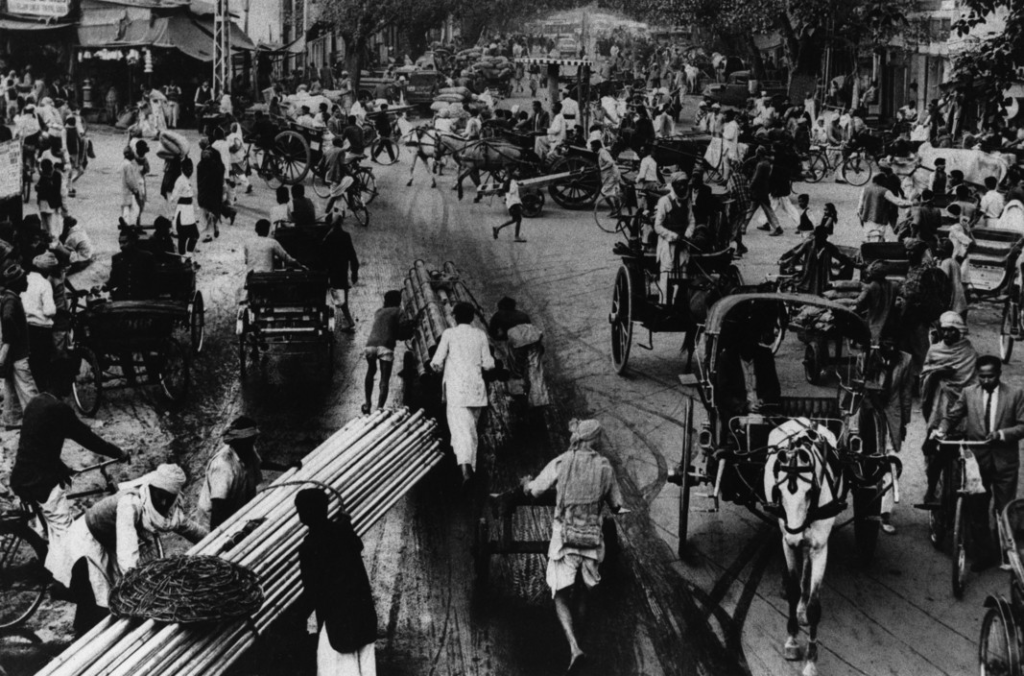
He is quick to grasp the critical visual mass amid the frenetic activity of the frame. Deftly divided into two halves by the dark wheel marks, the left and right of the frame are fixed as entry and exit points of the gaze. The triangle of carts being pushed in at the lower-left quadrant anchors our eye on the inward journey until the point where the wheel marks fade out. Precisely at that point, a boy in mid-stride crosses over to the right with our gaze in tow. It then follows the triad of tongas aligned in the right half, exiting at the place marked by the high-key presence of the horse. In my view, aligning the three vital components, that is, the carts moving inwards, tongas moving outwards, and the transition point provided by the boy, would have been the decision points to capture the decisive moment. The decision points do not mean to short-circuit the viewer’s gaze from entering the frame to exiting. They serve as spatial anchors and cairns, guiding the gaze travelling deep into the frame, facilitating the round trip, if we may. Creating subtle markers to see organisation in the chaotic is the work of a true genius!
In Rai’s seeing, the mundane becomes metaphoric, as if his gaze were touching something poetic. The relation between what we see and what we know is never settled, wrote John Berger in his seminal book Ways of Seeing. Aptly, the pictures of Raghu Rai are not a commentary, critique, eulogy or caricature but perhaps being all at once, or simply, the quietness. For example, his moving pictures from the Bhopal Gas tragedy in 1984 show him returning with reflection rather than indictment, poignancy rather than anger.
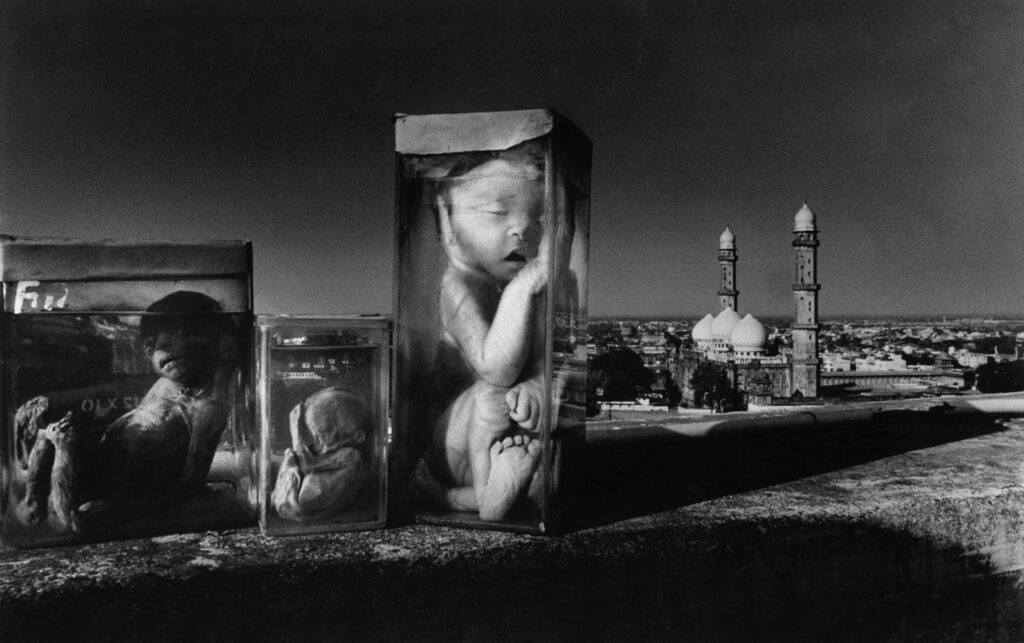
The above picture could have been taken in the laboratory, but Raghu Rai thought otherwise. He brought the jars of the stillborn children in formalin to the rooftop and placed them on the parapet in full view of the city these children would have inhabited. Three children now find echo in the three domes of the mosque in the background. It appears to be an act of bringing the children to light, freeing them from the cloistering glass jars, and resuscitating them. This is the sensitive gaze of the photographer.
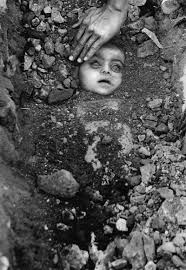
In this second picture from the Bhopal Gas Tragedy, the child being buried is accompanied by an assuaging hand, easing the journey to the other world. It makes the moment deeply human, the departure bearable, and the face, belong. Without the hand, we would have been looking at death much like a voyeur.
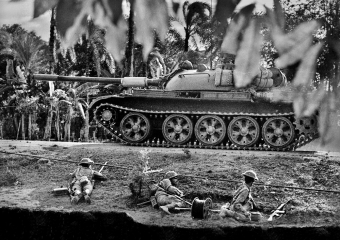
Fast rewind to 1971. Looking at his photo documentation from the Bangladesh liberation war, I drop anchor at an image of a tank rolling by on the street, with soldiers in battle gear in a prone supported position on the culvert, which abruptly ends in a ditch, as suggested by the dark space at the bottom of the frame. On the top and right-hand side of the frame, a canopy of leaves, out of focus and dodged, balances out the dark patch below. My eyes rest on the canopy of leaves above the marching tank. The composition makes me ponder the necessity of such elegance in the face of war happening in the background. I am transported to the video footage captured by my son Nirvair Singh Rai from the floods in Punjab in August last year. In the face of sheer destruction let loose by water, the innocence and gravitas of reeds reflecting in the water, swinging in the crimson light of the setting sun, leaves an imprint. Is it a reprieve for the gaze to drink up and soak the beauty of light and life before dipping and drowning in the dirge of destruction? Call it a paradox of focal length, proximity, the moment, or the photographer’s creative stance; you cannot help but include all facets of the unfolding sight. The result is an elegy, bordered with uplifting notes. The document of war stays a document of war, but embedded in the surroundings, it becomes both a critique of war and the idealism of landscape. Parallels can be drawn with the leaves dawning on the top in the above picture and of the caressing hand in Bhopal Gas Tragedy picture. Both the elements soften the blow and awaken hope.
About his appetite for the visual, Rai says “…But you cannot have enough. There is so much happening in front of you that sometimes I have to rely on a panoramic camera to grasp the multi-layered experience”. He desires further: “If I could capture with one click, the whole of this country…that’s the hunger I come from.” His desire to inhabit the people and the landscape echoes the greatest among the Indian art historians, Ananda. K. Coomaraswamy’s stance, that “as the student of arts, one must rather love than be curious about the subjects of his study.” Curiosity can get us a document, but chronicling life demands being in love; precisely the dictum Raghu Rai found himself bonded to, both as an ethic and in practice.
He was as much gripped by the scene as he was nostalgic for its passing. A perceptive viewer would notice a certain pang seeing his pictures because, invariably, they refer to somewhere else in spite of residing here. The everydayness of life is transformed into the epic in a celebration as well as a commemoration of the moment. The door to his images is ajar always, letting the viewer enter at will. Once in, the music reveals itself.
This enterprise of synthesis of the moment, form, and the inexplicability is the great unfolding: Darsan, in his own words. Forms echoing forms, relaying the rhythm of compositions in movement, transformed into a becoming. “Seeing after all is an imaginative, constructed activity, and an act of making. It is not simply the reception of images on the retina,” writes Diana Eck in her book Darsan (Eck, 14).
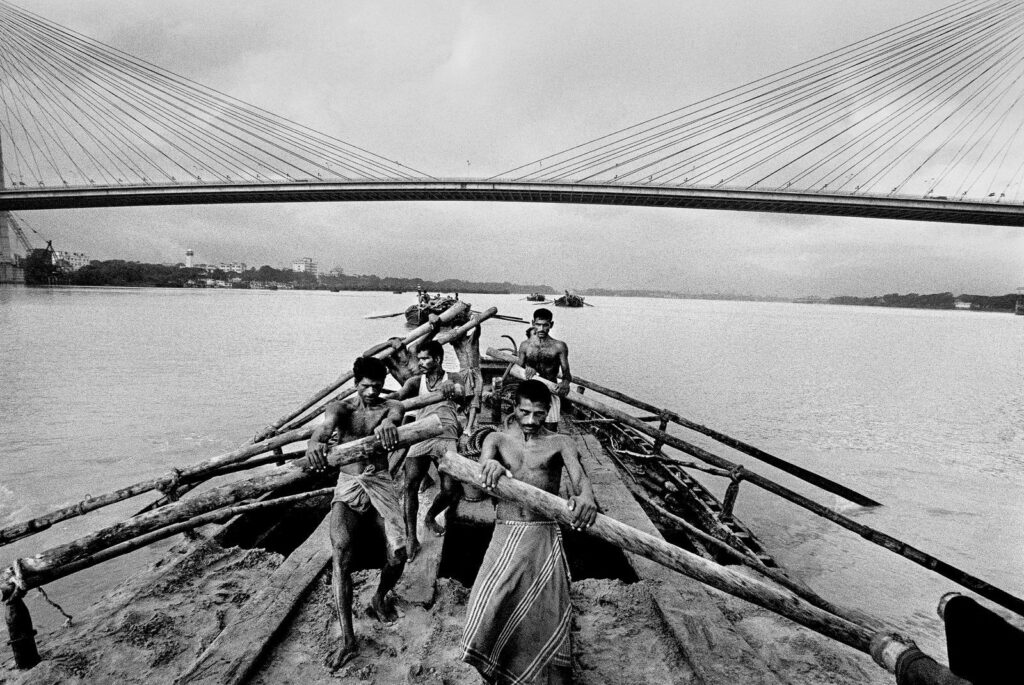
In this image of a rowboat, one can see how the oars held as a muscled extension of arms simulate the form of the bridge in the backdrop. Each sinew at work resonates with the taut ropes. Likewise, we find similar resonance of form in his images below, such as Woman Pushing a Cart and Shoulder to Shoulder, a shot from the Bangladesh Liberation War, and many more.
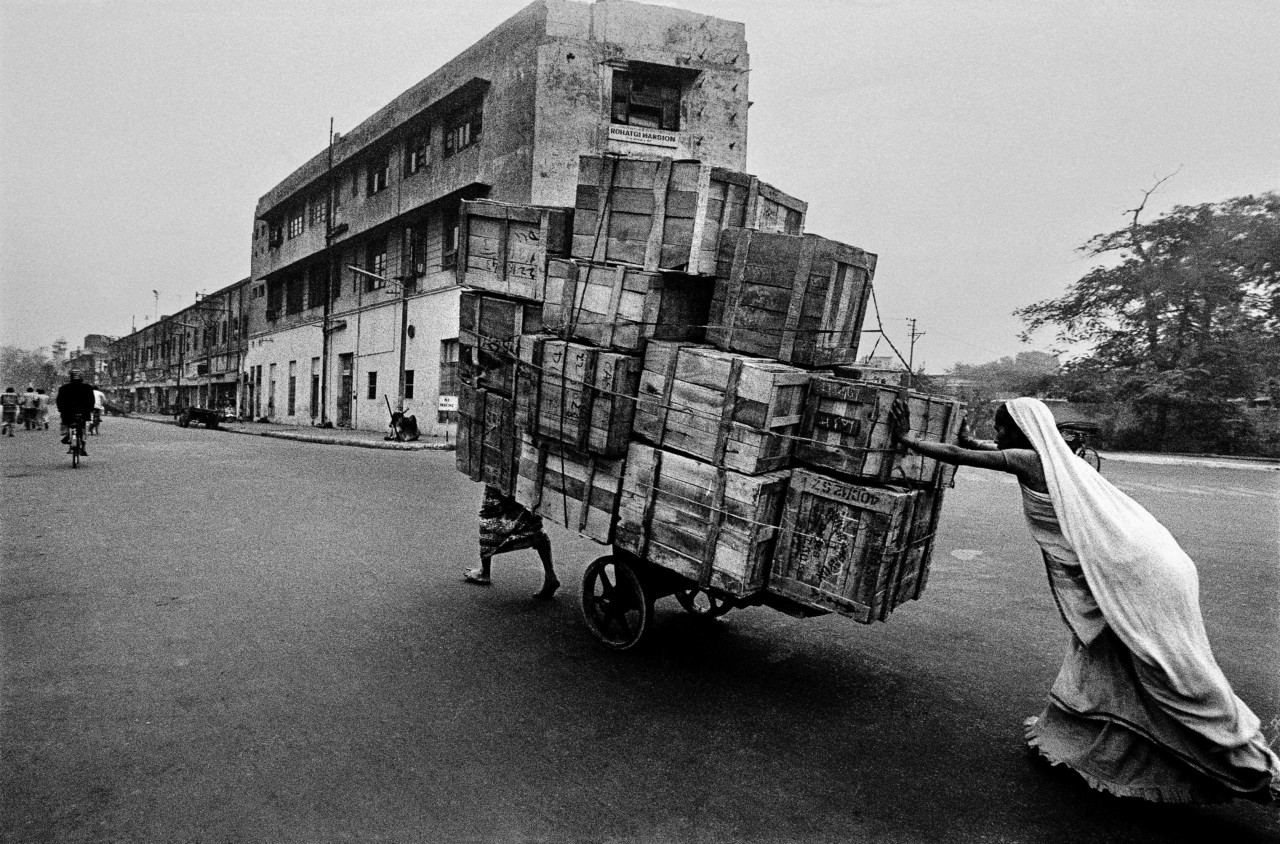
Dwelling on the first shot where a woman pushing a cart loaded with boxes has entered the frame. Raghu Rai positioned obliquely captures the scene just when the form of the cart melds with the building in the background. Great photographers organise space to contain more meaning. Had the shot been taken with the cart and the building as separate entities, the woman and the man would just be pushing a cart towards the building, the metaphoric point of consumption. But the creative stance of the photographer transforms the scene into extraordinary where they appear to move more. They become a moving force.
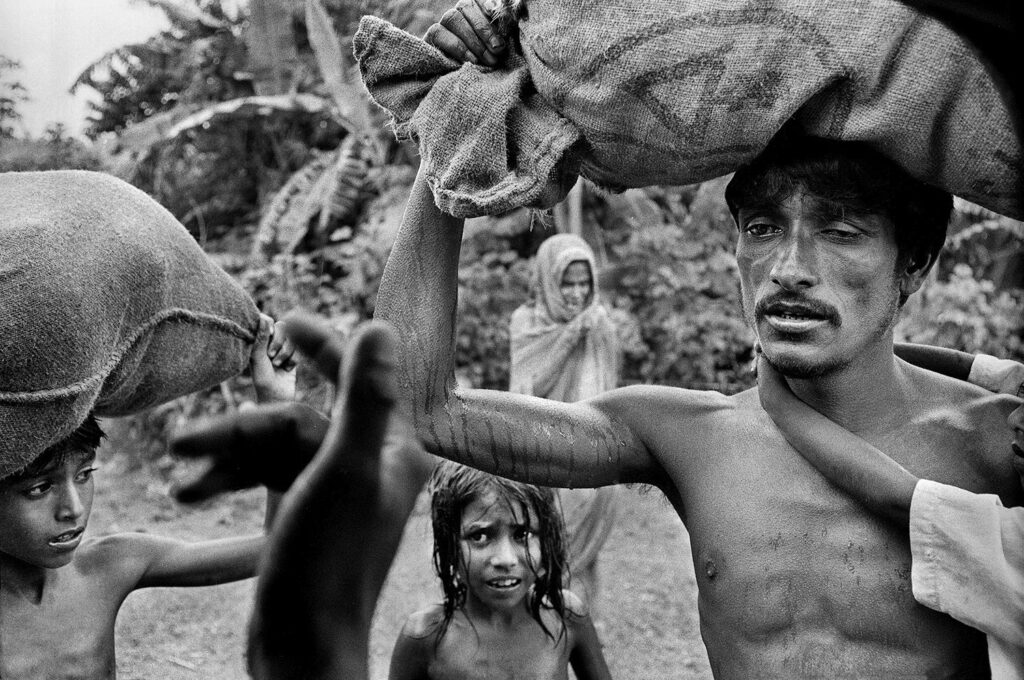
Let us look at this image from the Bangladesh liberation war. How the arms hold on to lifelines. How loops of arms going around a neck, a sack, become frames within frame uniting a family torn asunder; tenuous life trying to find refuge in the frail, strong arms. Life is longing running into each other in loops of naked, tender trust. Arms are all we have. Our hearts live in the arms.
As a photographer, Rai believed that the distance between the photographer and the subject was sacred. Not a step more, not a step less, he mentions in one of his interviews. The space became his personal temple of the moment. His understanding is reflected in one of the most anagrammatic images taken on the ghats of Hooghly.
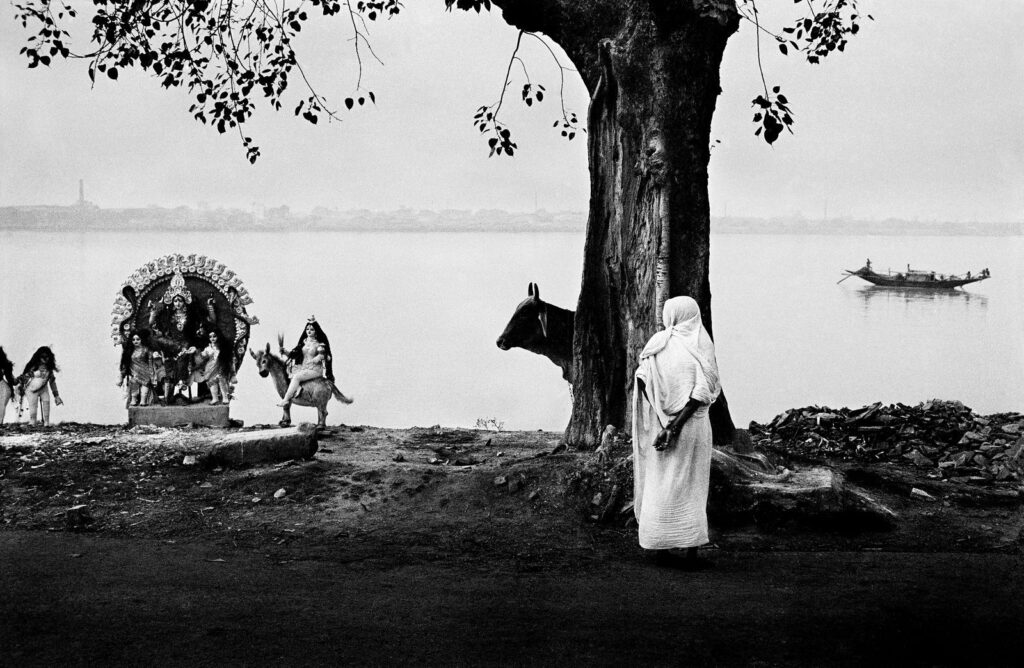
It is a simple, quiet photograph of a woman, a tree, a cow and a boat. But the “figure in the carpet” is revealed by dwelling on the image. The woman and the cow, which appear to morph with the limb of the tree, gently look towards the idols of Ma-Kali, aligning the viewer’s gaze with theirs. Dimensions of motherhood appear to emanate. In the background, the all-encompassing and enduring Ma Ganga. A boat, just into the picture on the right, visually balances the frame. Could this be the journey of life? All forms gently poised, in passing rather than waiting, the picture, an epic in itself, of time and tide. It speaks to the dictum of Walter Pater that “all arts approach the condition of music.”
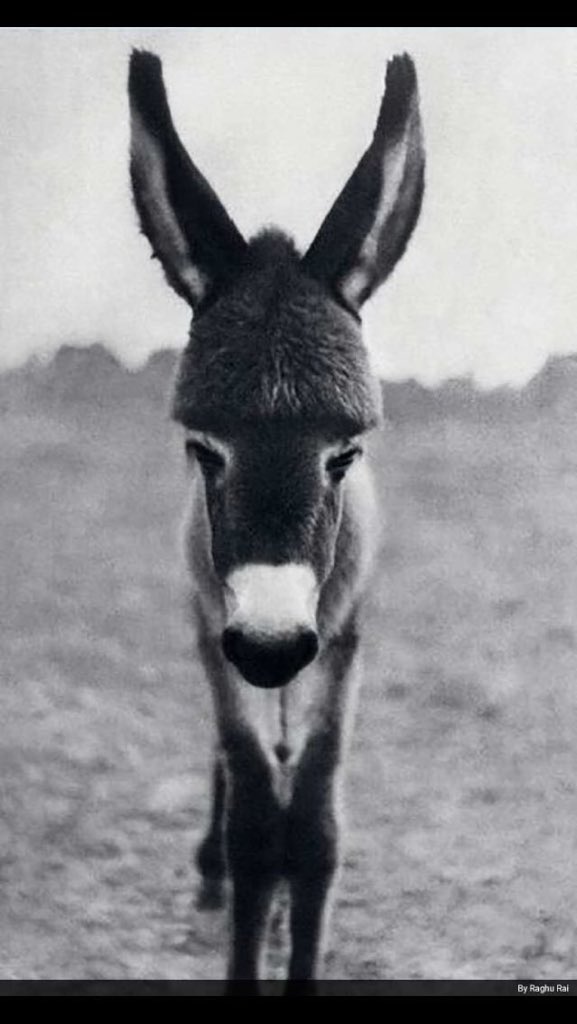
By now, the first picture taken by Raghu Rai is known to everyone. It was the picture of a dollop of fuzzy form, perhaps the most famous donkey in the world!
Raghu Rai chased the donkey with a borrowed camera, joined by the children on the street amused at the sight of a handsome young man fancying a donkey for a model. After an hour of running, the donkey got tired and gave in. That’s when the picture was taken. It got the attention of the international press, stamping the arrival of Raghu Rai. Equally important here is the bond he shared with the children in making the picture. They must’ve fed off each other’s excitement, shared the laughter, and brought out the child in Raghu Rai. That childlike simplicity and ability to move about and merge, unfettered by the societal gaze, became an integral part of his process of seeing and discovering through his eyes. Invisibility is a vital trait for a people’s photographer. One can do this either by hiding or dissolving into the surroundings. Raghu Rai practised the latter with elan. His love for the people left him with no choice but to be one among them.
The above image, understated as it is, often does not get the attention it deserves because of the subject and its simplicity. It underscores the cardinal principle of seeing with attention & involvement, free of hierarchy and order; the immediate being the only contingency. This image is perhaps the stamp of Rai’s touch, ingenuity and love.
All images used here belong to the respective copyright owner. They are used here under the Indian Copyright Act’s fair dealing provision.
References
Alka Pande, ‘Drishti: 75 Years of Indian Image Making’ (Museo Camera, 2022) 4
Diana Eck, Darsan: Seeing the Divine Image in India (Motilal Banarsidass Publications 1981)
Subscribe to the newsletter
Free. Independent writing on cinema and adjacent arts, delivered by email.
Subscribe