
Beyond Bollywood: Teaching South Asian Cinema in an American Classroom
My objective was to take students beyond Bollywood by introducing them with other film industries in South Asia that are equally vibrant.

By Fahmidul Haq ·
I migrated to the USA in 2019 with an experience of teaching film courses on world film history and film aesthetics, along with other courses on media and culture in Bangladeshi academia. While teaching at University of Notre Dame, Indiana, I noticed that there were many experts on American and European Cinema and comparatively fewer scholars on non-Western Cinema. In my first year there, I taught non-Western cinema encompassing all remaining continental cinematic practices such as Asian, African and Latin American Cinema. In the next year I narrowed the focus to Asian Cinema.
During these two pandemic-affected years, I was unable to fully experience the dynamics of an in-person classroom. Since 2021, after I began teaching at Bard College, New York, I have had the opportunity to experience an American classroom more fully. Bard has developed a small liberal arts classroom model in which the classroom sizes are small and teaching is intensive, highly engaging, and the learning process is active and experiential. Students are eager to learn and willing to be challenged by the professor. I teach here different courses on media such as Globalization and Media and Social Media and Activism. However, I teach at least one film course every year which is titled ‘Beyond Bollywood: Cultural Identity in South Asian Cinema.’ In this article, I present subjective reflections of a professor with a South Asian background who teaches South Asian Cinema in an American classroom.
The term “Bollywood” in the course title serves as a catchphrase for students and may be their primary point of reference for South Asian cinema. However, my objective was to take them beyond Bollywood by introducing them with other film industries in South Asia that are equally vibrant. And in that journey they encounter plenty of shocks and surprises.
The students should not be blamed for their limited knowledge about South Asian Cinema. Even in the globalized world, it takes time to know about a region or their cultural practices. For decades, Bollywood has been the flag-bearer of South Asian Cinema to the global audience. The industry got its current shape in the late-1990s with the local and international success for the films like Dilwale Dulhania Le Jayenge (1995), Hum Dil De Chuke Sanam (1999) and Kal Ho Naa Ho (2003). These films are produced in a liberalized market with hybrid cultural values of both Indianness and global and by targeting NRIs as potential spectators (and satisfying the local audience too). The storyline often traveled to European or American cities; however, the characters always remain Indian by heart. In 1998, the Indian government granted film production an ‘industry status’ and foreign equity was allowed up to 100% in 1999. Rajadhaykhsya (2003) describes this whole process as ‘the Bollywoodization’, observing that the marketing part of the Bollywoodization was missing in the South Indian industries which were very much locally oriented. They were used to be called as ‘Regional Cinema.’
However, in recent years, the scenario has changed but it did not change the perception of American/Western people (that include my students). When the ‘Naatu Naatu’ song got the Academy Award, the host of the award giving ceremony, Jimmy Kimmel described RRR a Bollywood movie. My students generally do not know that since the local and global success of Telugu film Bahubali: The Beginning (2015) the application of the Bollywoodization (Rajadhaykhsya suggests the marketing method of Indian films for global audience) can be seen in the South Indian films industries too. This time, the productions like Bahubali 2: The Conclusion (2017), Pushpa: The Rise-Part 1 (2021), RRR (2022), K.G.F.: Chapter 2 (2022) got a new identity – ‘pan-Indian’ cinema. These films are produced from South Indian cities like Tamil Nadu, Hyderabad, Kochi, and Bangalore, dubbed to Hindi and released for pan-Indian audience and thus they have been becoming the highest grossing films in India. According to the box office reports provided by IMDB, among the 10 highest grossing films in 2021 only two were from Bollywood. In terms of critical acclaims, South Indian films are dominating the scenario, especially the Malayalam film industry from Kerala is best known for their arthouse contents. Film Companion, a now-defunct platform of critics, published the lists of ‘The Best Indian Movies of 2021’ and among 15 selected films, only three films were produced from Bombay, two in Hindi and one in Marathi language. All other films were produced in South Indian cities. I am presenting all these data from 2021 onward because that was the period when Bollywood began to lose its once-obvious position as India’s leading, and widely perceived national, film industry.
Under the dominance of fiction films, the top-notch international success is bagged by Indian documentary filmmakers. Rintu Thomas and Susmit Ghosh’s Writing with Fire (2021) was nominated in Academy Award 2022. Shaunak Sen’s All That Breathes (2021) won the top documentary award (Golden Eye) at Cannes 2022. Kartiki Gonsalves’ The Elephant Whisperers (2022) got Academy Award as the best documentary in short film category. None of these projects were set in Bombay or based in Bollywood. The director of the film All We Imagine as Light (2024), Payal Kapadia may be based in Bombay, but not a Bollywood director.
Bollywood still may feel proud of the low-budget, content driven and independent-esque New Bollywood Cinema initiated by Anurag Kashyap and his friends. But it has almost lost its glory of its signature characteristics – big budget and masala movies based on formulaic song and dance numbers. Shahrukh Khan starrer action films Pathaan (2023) and Jawaan (2023) rescued Bollywood for a while, yet his production company had to bring on Atlee as the Southern director for Jawaan, along with Nayanthara and Vijay Sethupathi as the film’s lead actors.
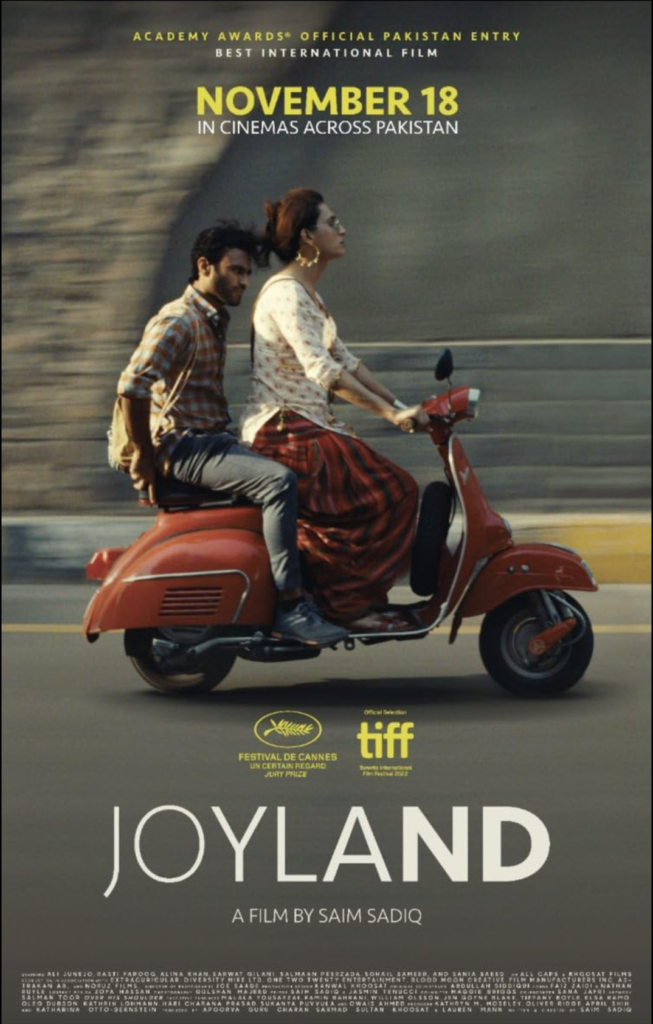
All these discussions surprise my students and they love to learn about South Asian Cinema by stepping out from Bollywood. They see the other South Asian industries are shinning too. Since Bol (2011), Pakistan has been experiencing a New Wave and the country has been producing fiction films that are both critically acclaimed and commercially successful. Canada based Pakistani filmmaker Sharmeen Obaid-Chinoy won academy awards twice for her documentaries Saving Face (2013) and A Girl in the River: The Price of Forgiveness (2017). Saim Sadiq’s Joyland (2021) won the jury prize at Cannes 2022 in the Un Certain Regard category. International success of the big budget film The Legend of Maula Jaat (2022) suggests that non-Indian South Asian industries have also learnt the mastery of the Bollywoodization.
Bangladesh has been experiencing an independent film movement since the 1980s and the country has produced a lot of remarkable films such as Matir Moina (2002, FIPRESCI award at Director’s Fortnight, Cannes) by Tareque Masud and Television (2012, won Grand Jury Award at Asia Pacific Screen Award) by Mostofa Sarwar Farooki. Abdullah Mohammad Saad’s Rehana Maryam Noor (2021) was in competition at Cannes 2022 in the Un Certain Regard category. The short film Ali (2025) by Adnan Al Razeev got a special mention award in Cannes’ short film category. Rubaiyat Hossain’s The Difficult Bride (2026) was an official selection at 83rd Venice International Film Festival in the Orizzonti competition section and bagged Premio Bisato d’Oro (Independent Film Critics Award) prize. Other international achievements may include Kamar Ahmad Simon’s Are You Listening! (2012) winning Grand Prix at Cinema Du Reel, Iqbal Hossain Chowdhury’s Boli (2023) winning New Currents Award at Busan and Rezwan Shahriar Sumit’s Master (2026) winning Big Screen Award at Rotterdam. A new generation of filmmakers has already arrived in the scenario and has been exploiting the possibilities of the OTT platforms and continuing making films for the big screens. The Bollywoodization method has been adopted by the Bangladeshi producers too. Bangladeshi films are regularly being released at the mainstream theatres in North America, the UK and Australia targeting NRBs (Non-resident Bangladeshi) as spectators and earning substantial revenues that include Hawa (2022, dir. Mejbaur Rahman Sumon) and Bonolota Express (2026, dir. Tanim Noor).

I get a few American students; however many of them have South Asian backgrounds, including a significant number of Afghan students. I am surprise to learn in class that many of them are not familiar with films from their own countries. After watching Siddik Barmak’s Osama (2003), the world came to know that Afghanistan too produced great films. Atiq Rahimi’s Earth and Ashes (2004) was in competition in Un Certain Regard category at Cannes. The Oscar-nominated short film Buzkashi Boys (2011) by Sam French was an Afghan-US co-production. Gulistan Marzaei and Elizabeth Marzaei’s Three Songs for Benazir (2021) was another Academy Award nominated film in short documentary category. There was a significant rise of women filmmakers in Afghanistan who mostly made documentaries and the list of the names is quite long – Sahraa Karimi, Shaharbanu Sadat, Sahra Mani and Roya Sadat. After the Taliban takeover in August 2021, Sahraa Karimi, the chairperson of the Afghan Film Organization had to leave country and Afghan Cinema is now in real crisis again.
Buddhist monk Khyentse Norbu from Bhutan directed several award-winning films that includes The Cup (1994) and Travelers and Magicians (2003). His assistant Pawo Choyning Dorji made Lunana: A Yak in the Classroom (2021) and got academy award nomination in 2022. Since Nischal Basnet’s Loot (2012), Nepalese Cinema has been shinning too. Abinash Bikram Shah’s Elephants in the Fog (2026) won the Jury Prize in the Un Certain Regard section Cannes. Long ago, Sri Lankan master filmmaker Lester James Peries’ films were nominated for Palme d’or at Cannes and won silver lion at Venice. However, along with India, Pakistan, Bangladesh, and Nepal are the South Asian countries that can be considered truly cinephile societies, where international success is less important to large audiences, given the prominence of mainstream cinema production and film as an established form of popular culture.
All these discussions are new to my students and they gradually develop interest in South Asian Cinema. They also become more open to moving beyond what they initially expected – ‘all Bollywood stuff’ – and embracing what they actually encounter: the diverse film cultures of South Asia. They do not lose their interests when I start discussing how cinema as a medium shapes the cultural identity of the region by exploring the following topics: the Partition of India in South Asian cinema, Bollywood’s cultural influence in other South Asian countries, the portrayal of Kashmir and Pakistan in Indian cinema, and new and independent cinematic practices, both parallel to and within the mainstream industry. The only dissatisfaction I have in teaching a course on South Asian Cinema for a new generation American students is their general disinterest in black-and-white films. As a result, they often show limited interest in and appreciation for films by Bengali arthouse filmmakers such as Satyajit Ray, Ritwik Ghatak and Mrinal Sen, as well as Golden Age Hindi filmmakers such as Guru Dutt, Bimal Roy and Raj Kapoor. The structure of the course with its ambitious goal of covering all major South Asian film industries and exploring cultural identity, does not allow sufficient time for an in-depth appreciation of the creations by those masters.
I never thought of designing a course on South Asian Cinema when I used to teach in South Asia (i.e. Bangladesh). People grow up there within a South Asian film culture, and they do not necessarily feel the need to teach or learn about it, although they know very little about other South Asian film cultures beyond India. I was more interested about teaching European and American film cultures under the broader framework of World Film History.
In the United States, as a film scholar, I was, knowingly or unknowingly, looking for an identity (both as an immigrant and as an academic) that led me to this direction: teaching the cinema of a region, in which I have expertise, and my colleagues do not generally specialize in. I assume that my students were also interested in take a course whose title reflected the professor’s identity and expertise in this area.
The course allowed me to discuss Bollywood’s hegemonic influence on other South Asian film industries as well as India’s perceived ‘big brother’ role in South Asia. Moreover, I could freely critique Bollywood’s negative portrayals of Pakistanis or Kashmiris on screen, something that might not as easy for an Indian professor to do in the same way in an Indian classroom.
On the other hand, introducing students to nearly an unknown cinematic universe, is deeply satisfying as a teacher. In short, teaching South Asian Cinema in an American classroom is rewarding to me in many ways.
Reference
Rajadhaykhsya, A. (2003). The ‘Bollywoodization’ of the Indian Cinema: Cultural Nationalism in a Global Arena. Inter-Asia Cultural Studies. 4:1, 25-39.
Subscribe to the newsletter
Free. Independent writing on cinema and adjacent arts, delivered by email.
Subscribe