
Between Two Screens: Golcha, Delite, and the Vanishing Public Life of Delhi
The city knows how to protect Mughal and colonial structures; it can speak the language of monuments and empire. But it struggles to comprehend mid-century public architecture, and the cultural worlds they housed

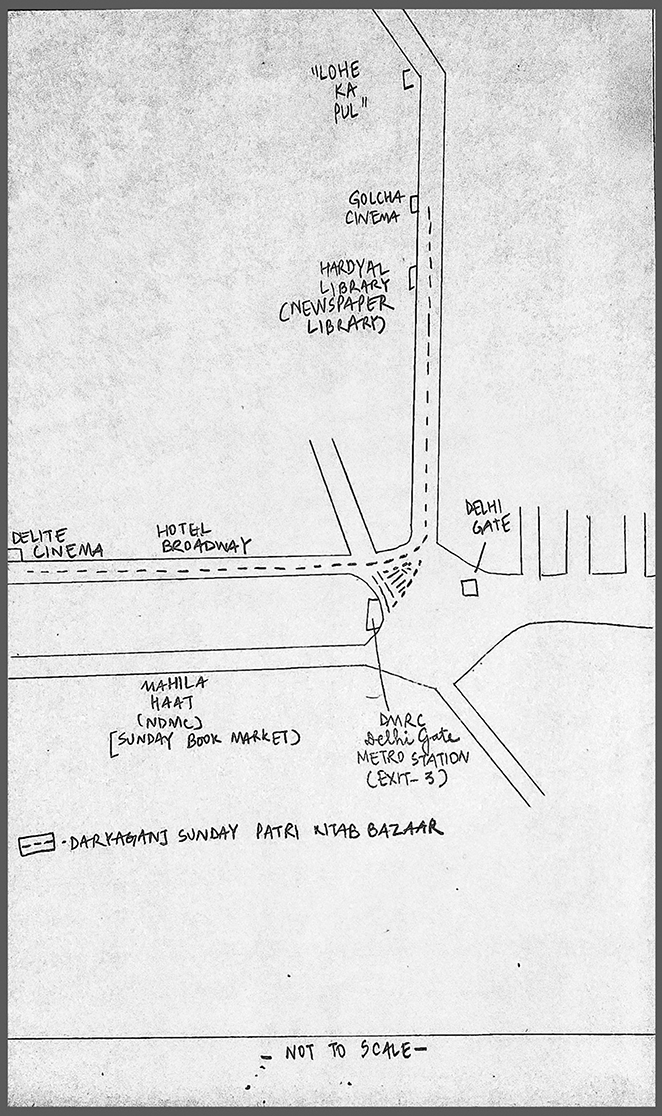
I did not set out to write about Golcha and Delite. When you have lived in Delhi long enough, the disappearance of single-screen cinemas becomes background noise. Regal, Vishaal, Moti, Alpana, Shiela, each shut down with the weary inevitability of a city shedding its past one façade at a time. If one wished to mourn them, there was no shortage of ready-made laments. My project, meanwhile, lay elsewhere: I spent years walking and re-walking the Sunday Book Bazaar of Daryaganj, interviewing its sellers, mapping its old geographies, and tracing its shifting afterlives as the bazaar was pushed from its porous street existence into a gated enclosure in 2019. While documenting the book bazaar and its absence, I found myself returning, with growing insistence, to two cinemas at the edges of that world.
The L-shaped route between Golcha and Delite became a kind of ethnographic refrain. Week after week, I passed Golcha’s locked gates, its peeling pink paint and shuttered ticket windows holding the outline of a life abruptly interrupted. The silence around it was unsettling: no murmured anticipation before a show, no coins clinking at the box office, no projector buzz heard faintly through the walls. A little further down, Delite stood stubbornly luminous. Its chandeliers reflecting amber light, staff adjusting velvet ropes with a pride that seemed out of sync with the city’s forgetfulness. The dignitaries might return any day. That short walk began to reveal that the two halls were not simply neighbours. They formed a cultural corridor, two architectural punctuation marks bracketing a world of cinema, books, commerce, sociability, and everyday life that Delhi no longer remembers.
It is difficult to explain how ethnography reorients attention. When you revisit a neighbourhood for as long as I did, interviewing sellers, following their movements, learning their memories of the bazaar when it ran along the full spine of Daryaganj, you begin to notice what has fallen out of narrative, what stands in plain sight and yet remains unspoken. Hundreds of buildings slip quietly from the city’s imagination each decade. But something about the corridor between Golcha and Delite refused to disappear into that blur. In 2019, when the bazaar was forcibly relocated behind gates at the Mahila Haat, the street thinned, the footfall changed, and the walk between the two cinemas felt newly exposed, newly legible. With the corridor emptied of its crowds, the relationship between the two halls emerged more starkly: one was already dark, the other still glowing; one collapsing into disuse, the other performing a fragile endurance. Understanding their stories required understanding them together.
Golcha and Delite make little sense when separated from the street culture that once connected them. Golcha did not decline solely because of competition from multiplexes or the spread of new leisure habits. Its life and eventual collapse were inseparable from the fate of the bazaar, the density of the pedestrian corridor, the rhythms of the neighbourhood, and the patterns of everyday public life that sustained the area. Delite’s continuing survival, by contrast, emerges from a different geography, anchored to Delhi Gate, ITO, student hostels, court complexes, and morning walkers; a more stable set of publics with distinct rhythms of their own. This divergence is not accidental.
Standing before Golcha today, the first thing one notices is the void. Designed by W.M. Namjoshi and opened in 1954, Golcha was once considered among the finest cinemas in north India. It bore the influence of Bombay’s Art Deco movement, though softened for Delhi’s topography and light. The façade’s geometric curves and stepped profile, the gleaming terrazzo floors inside, the sweeping staircase catching light from above, the acoustically considered interior. All of it expressed a moment when cinema architecture in India aspired to be a form of glamour embedded within everyday life. Golcha was not an elite space; it was a democratic one. Families, clerks, students, tourists, young couples, children, all shared the theatre without self-consciousness. The hall played family dramas, thrillers, comedies, and blockbusters with equal seriousness. It created a genre of belonging.
But a cinema like Golcha could survive only within a certain ecology of the street. In the 1970s, 80s, and even early 90s, Daryaganj thrived as a mixed zone of offices, printing presses, neighbourhood groceries, small eateries, family homes, travel agencies, paan corners, and the Sunday bazaar that brought thousands of people each week. The bazaar was not just a marketplace; it was a pedestrian engine that kept the street animated and porous. A cinema embedded in such an environment thrived on spontaneity. People dropped in after browsing books, bought interval snacks before catching a bus, wandered into a matinee because they had time to spare. Single screens lived on the volume and unpredictability of such flows. Golcha’s decline began when those flows thinned.
By the late 1990s, Daryaganj was losing its heterogeneity. Businesses moved to Barakhamba Road and Connaught Place; lawyers shifted toward Saket and Noida; families relocated to West Delhi; government offices decentralised; and the construction of flyovers in the 2000s redirected foot traffic away from the old arterial streets. The day-long sociability of the neighbourhood weakened. The bazaar alone could not hold up the ecosystem. Meanwhile, television, cable networks, and home entertainment systems drew people indoors, reducing the communal dimension of watching films. Golcha’s auditorium, designed for immersive collective experience, found itself serving a shrinking audience. It withered because the city around it had transformed.
When the bazaar was relocated off the main street in 2019, the corridor effectively broke. The move was framed as an administrative solution to congestion and “encroachment”, but its cultural consequences remain far less discussed. The removal of the bazaar drained the street of one of its last remaining engines of public life. Golcha had already shut by then, but the removal clarified its story: cinemas do not vanish in isolation; they vanish with the streets that once made them meaningful.
Delite’s place in the city is also shaped by the care with which it has been maintained. Over the decades it has hosted an extraordinary range of visitors, including and not limited to Jawaharlal Nehru, S. Radhakrishnan, Zakir Husain, the Kapoor family, Madhubala, Shah Rukh Khan — a reminder of the cinema’s long-standing cultural standing in Delhi. In the early 2000s, when many single screens were surrendering to new forms of leisure, Delite underwent a renovation that strengthened rather than erased its mid-century grammar. Rather than replacing its heritage with a gleaming mall aesthetic, the owners invested in preserving its sense of occasion: Belgian crystal door handles, Czech chandeliers, carved woodwork, a hand-painted dome in the Diamond auditorium that recalls the ceremonial grandeur of a durbar hall, brocade seats and Egyptian-woven carpets that make the auditorium feel like a civic parlor. The enhancement was accompanied by technical updates too, such as an improved sound system and acoustics, so that the cinema could offer both the pleasure of preserved interiors and the quality expected of contemporary exhibition.
This attention to atmosphere has been matched by an insistence on accessibility. Delite keeps its prices low, with tickets starting at ₹70, ensuring the cinema remains available to a broad spectrum of publics: students, office-goers, neighbourhood residents, families seeking an affordable matinee. Its concessions reflect the same democratic logic: fries, chuski, popcorn, and the now-famous “Maha Samosa,” while a modest food court serves inexpensive North and South Indian meals. For many visitors a matinee at Delite is followed by a lunch at Bhaja Govindam next door; yet another small ritual that links the cinema to the everyday life of the street.
This combination of curated heritage, technical investment, affordable pricing and food culture is precisely what has allowed Delite to endure: it did not survive merely because it was useful, but because it made usefulness legible as value. The owners’ private conviction that a cinema could remain a landmark, paired with the cinema’s anchoring in multiple circuits of movement, produced the conditions for a single-screen hall to persist in a city that otherwise forgets its modern public architectures.
The difference between Golcha’s decay and Delite’s endurance points to the broader failure of Delhi to recognise and preserve the architecture of its own modernity. The city knows how to protect Mughal and colonial structures; it can speak the language of monuments and empire. But it struggles to comprehend mid-century public architecture, and the cultural worlds they housed: cinemas, community halls, markets, auditoriums, modernist housing, Art Deco façades. Golcha was never listed as heritage, never shielded from neglect, never granted the dignity of being considered part of Delhi’s architectural story. The city forgot it while it was still standing.
It is tempting, at this point, to assume that cinemas vanish because they are spaces of public utility and therefore more vulnerable to market pressures than monuments. But utility alone does not determine survival. Delhi routinely renovates, rebrands, and protects spaces of high use: metro stations, malls, arterial roads, even certain parks. They align with dominant imaginations of what the city should look like. What makes single-screen cinemas precarious is not their usefulness but their mode of usefulness: slow, local, inexpensive, communal. Their publics are neither affluent nor legible within contemporary redevelopment priorities. Their pace is wrong, their aesthetics are wrong, and their revenue model is wrong.
Golcha complicates this even further. As one of Delhi’s few surviving Art Deco structures, its façade and interiors carry clear architectural significance; precisely the kind of value that should have made it eligible for preservation. Yet even this did not save it. Its architectural merit was eclipsed by the fact that it belonged to a form of public life the city no longer knows how to support or defend. In other words, Golcha does not disappear because it was a space in use; it disappears because its way of being public, even with its Art Deco pedigree, no longer aligns with the city’s preferred public worlds.
This forgetting is not simply architectural; it is social. Cities remember unevenly. They monumentalise some histories and let others fade. Golcha represents a memory that the city allowed to disappear: the memory of cinema as a shared ritual, of neighbourhood crowds, of cheap tickets, of sudden plans, of pavements thick with life. Delite represents the thin survival of a memory still enacted. The collective hush before a show, the applause at interval, the quiet pleasure of watching a film in a hall large enough to feel like a public event. These memories are infrastructural. They depend on the spaces that hold them, and on the streets that feed those spaces.
When a city stops protecting the places where people gather—cinemas, bazaars, pavements, commons—it begins to lose more than built form. It loses the everyday habits that enable collective life. The decline of single screens in Delhi is often narrated as a story of technology: multiplexes, changing tastes, digital streaming, shrinking attention spans. But Golcha and Delite reveal a different truth. The collapse of single screens in Delhi is inseparable from the shrinking of public culture itself. A cinema is not merely a screen; it is a node in a dense social fabric. When the fabric thins, the node begins to dim.
This insight, enabled by slow, repeated walking, reshapes the narrative. For decades, Daryaganj’s Sunday Book Bazaar stretched roughly between Golcha and Delite. It created an ecology in which literature, leisure, commerce, and cinema intertwined. One could watch a matinee at Golcha, step out to browse Urdu poetry, engineering guides, romance novels, children’s books, or pirated bestsellers, drift toward Delite through the afternoon crowd, stop for soda or samosas, and then catch an evening show. Cinema and books coexisted on the same street, each amplifying the other’s atmosphere. When the bazaar was moved behind gates, this ecology collapsed. The corridor ceased to function as a cultural spine. The thinning of the street was not merely a logistical change; it was a cultural rupture.
In cities like Bombay or Kolkata, where street cultures remained robust longer, single screens survived deeper into the 2010s because the public life around them remained porous, dense, and social. Delhi, by contrast, experienced a more severe contraction of street publics due to urban planning decisions, security regimes, infrastructural changes, and shifting class geographies. Golcha’s disappearance must be understood within this context. It did not die because “multiplexes killed single screens”. It died because Delhi narrowed its own spaces of gathering.
This brings us to the role of memory. Cities often narrate their pasts through monumental structures: forts, gates, boulevards, historic havelis. Meanwhile, the ordinary architectures that shaped daily experience remain unacknowledged. Golcha was one such architecture: not monumental but meaningful. Its neglect illustrates what happens when a city’s memory becomes selective. Delite, though surviving, stands as a reminder of how fragile that memory can be.
To walk from Golcha to Delite today is to walk through this uneven terrain of memory. At Golcha, the silence feels absolute, as if even the ghosts have decamped. At Delite, the glow persists, softer now but real. Between them lies a corridor where books once spilled onto pavements, where the bazaar animated Sundays, where cinema halls welcomed unsegregated crowds, where the city felt momentarily coherent. Walking that route during my years of fieldwork allowed me to see that these two cinemas were endpoints of an entire cultural world. Their fates are inseparable, and they tell us something crucial about Delhi’s priorities, erasures, and future.
What remains, finally, is a note of caution. When a city stops valuing the everyday infrastructures that enable collective life, it edges toward a diminished civic imagination. The story of Golcha and Delite is not nostalgia; it is urban diagnosis. It shows how a city erodes its public cultures, breaks its spatial continuities, abandons its modern heritage, and remembers selectively. If Delhi wishes to understand what it has lost, it must pay attention not only to the ruins of its ancient past but to the ruins of what was alive just a decade ago.
Image credit: Image from author’s book, Old Delhi’s Parallel Book Bazaar (CUP 2024)
Subscribe to the newsletter
Free. Independent writing on cinema and adjacent arts, delivered by email.
Subscribe