
A Pakistani Afterlife for Les Misérables
What arrives in Salakhain is therefore not quite the novel but its afterlife: a familiar arrangement of misfortune and moral arithmetic portable enough to cross languages, industries, and continents.

By Manahil Tahira ·
How Salakhain turned the French epic into a man’s search for his daughter
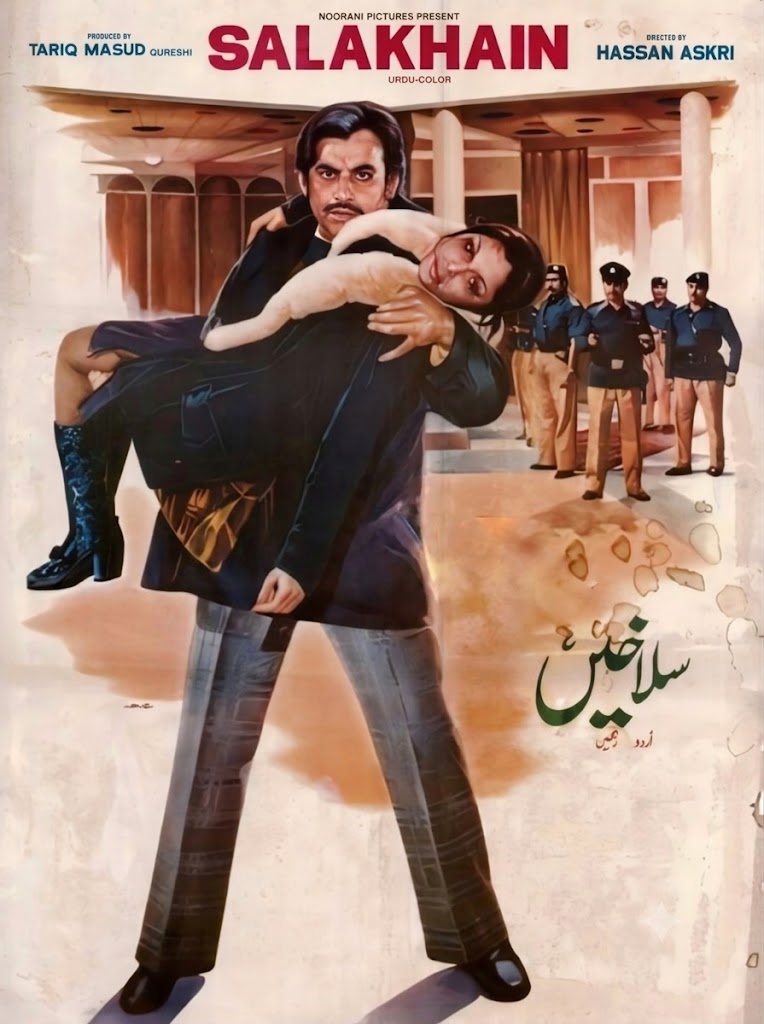
Bruised and bandaged after being struck by a car while riding his bicycle, Badar regains consciousness in a hospital ward as a thunderstorm gathers outside. Lightning flashes across the windows and thunder rolls through the building as he realizes his young daughter, Abida, has been left home alone. He rushes back to find her soaked by the rain and burning with fever. The doctor diagnoses double pneumonia and warns that without medicine, she will not survive. Unable to pay for the costly prescription, Badar is refused treatment by the pharmacist. Faced with the certainty of his daughter’s death, he breaks into the pharmacy to steal the medicine, only to be arrested and sentenced to prison.
For nearly half an hour, Pakistani director Hasan Askari’s Salakhain (1977) gives little hint that it is unofficially adapting Victor Hugo’s 1862 novel Les Misérables. Instead, it spends its time checking off the standard, comforting boxes of the Pakistani social film, the kind of routine misery found in Saiqa (1968) or Pehchaan (1975), where a character must be thoroughly broken by poverty, sick mothers, separation, or a marriage against parental wishes before the “actual plot” can even begin. As film scholars Ravi Vasudevan and Kamran Asdar Ali have argued in their respective studies of Hindi and Urdu cinema, the “social film” was less a discrete genre than a melodramatic omnivore with a grand appetite for multiple plots and generic registers.1 The basic tenets of social film as identified seminally by Vasudevan and the wider Indian scholarship on mid-century cinema hold for the development of the “Pakistani Urdu Social”: the all-too familiar camera-facing “frontal” mode of address, melodrama, action and stunts, song-and-dance sequences, architectural interiors, and defining moral quandaries make Salakhain a fitting example of the genre.2
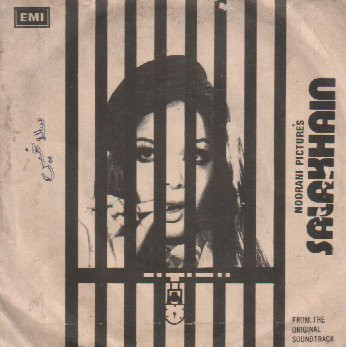
While the central plot and characters in the film strongly resemble Les Misérables, the definitive source from which Salakhain borrows is impossible to establish, assuming Hugo’s novel was ever the direct source at all. By 1977, Les Misérables had already lived several cinematic lives, passing through stage productions, radio dramas, television serials, and film adaptations that performed the same necessary violence: taking Hugo’s 1,300-page monument of suffering and reducing it to its most usable parts — the unjust imprisonment, the dying child, the ruined woman, and the redeemed criminal. What arrives in Salakhain is therefore not quite the novel but its afterlife: a familiar arrangement of misfortune and moral arithmetic portable enough to cross languages, industries, and continents.
That is perhaps why the more interesting question is not whether Hasan Askari made “Victor Hugo in Pakistan,” but why such a phrase feels both surprising and strangely obvious. Pakistani melodrama had already perfected the machinery that Les Misérables required: families broken by circumstance, poverty mistaken for moral failure, love interrupted by social hierarchy, and suffering elevated into evidence of virtue. To focus on Hugo’s arrival in Pakistani cinema risks overlooking the more revealing transformation: how a French nineteenth-century epic was domesticated through the conventions of Urdu melodrama. Askari and screenwriter Riaz Arshad were adapting Les Misérables, certainly, but they were also demonstrating the elasticity of Pakistani cinema.
That process of domestication begins long before audiences recognise Hugo’s plot. Even as Badar navigates the ruthless prison system in direct echo of Les Misérables, repeatedly attempting escape and extending his sentence to twelve years, he is never simply Jean Valjean translated into another language. Played by Mohammad Ali, Badar easily brings to mind the actor’s wrongly imprisoned hero of Insaaf Aur Qanoon (1971), who tearfully confronts the bench’s painful miscarriage of justice: “Give me back twelve years of my life. Return my youth to me, my desires, and my longings. Today, I will see how powerful justice and law really are.” An indomitable superstar of his time, Ali played wise-eyed heroes on screen who invariably found themselves fighting structures and larger-than-life forces. For someone whose celebrity was crafted precisely as an impoverished graduate struggling to find a job, a man frequently on the begrudging side of law, or a general stickler for morality, provincialising Jean Valjean came easy. It is this ease that shows just how much Pakistani melodrama relied on star personae to make unfamiliar narratives immediately legible. Thus, audiences recognised not only a character but an already established moral presence: a body whose gestures, vocal inflections, and screen persona carried memories across films. Around this familiar figure accumulated an equally familiar visual and narrative vocabulary. Thunderstorms externalised emotional turmoil; song sequences interrupted and advanced the narrative; theatrical frontal compositions, interchangeable domestic interiors, comic detours, wedding nights, and rape scenes returned with ritualistic regularity.
Pakistani cinema, lacking the avant-garde movements or industrial stability that might have produced a more self-conscious formal language, instead developed through repetition — refining a repertoire of recurring signs that audiences could instantly decode. Foreign stories entered this system already transformed, absorbed into a melodramatic grammar in which recognition mattered more than origin. By the time Salakhain reveals itself as Les Misérables, Hugo’s novel has already been made to look and feel unmistakably Pakistani.
Both Les Misérables and Salakhain begin with a criminal being offered a second life, but Hugo makes that transformation almost impossibly generous. Jean Valjean arrives at Bishop Myriel’s door carrying a yellow passport that announces his criminality before he says a word. He expects the usual response: suspicion, rejection, another reminder that the world has already decided what he is. Instead, after Valjean steals the Bishop’s silver and is caught by the police, Myriel simply gives it to him. Not only does Valjean leave prison, but he also leaves Jean Valjean behind. As Monsieur Madeleine, he builds a factory, saves a town, and acquires the wealth and respectability that were once impossible for him.
Salakhain keeps the skeleton of Valjean’s transformation but swaps out its engine. Badar arrives not at the home of a saint but at the doorstep of a judge, carrying twelve years of prison, an ageing body, and a lifetime’s worth of grievances. The gods took his wife, society took his daughter, and the state took his youth. Despite these few invocations of god, Askari’s film subscribes to the decade’s distilled religiosity. Christian morality in all its scriptural halo is a widely identified symptom of Hugo’s work, including Les Misérables. Barring a few religious-nationalist films, most prominently filmmaker Riaz Shahid’s Pan-Islamic engrossments, ’60s and ’70s Pakistani cinema mainly drew its didactism from a religiously inflected ideal of tradition instead of scripture. Therefore, no sermons abound in Salakhain, even though plenty of aphorisms and sage advice are dispatched. Conversely, that a retired judge replaces Hugo’s saint is not just a convenient bypass of the original’s Christianity. One may be tempted to read in its irony — Badar is both ruined and rescued by a man of law — a weak exculpation of the state. This “defence”, when set against other films and director filmographies, traces a seductive belief that mars many uprisings and parts ways from Hugo: a belief in the structure as fundamentally malleable, at the mercy of its handlers. What wreaks havoc on Badar are not the rigid words of law, as Les Misérables would suggest, but what the men in its employ make of it. Put simply, Badar’s misfortune is that the good guy, the judge, has retired, and the bad guy is yet to.
As in the novel, the judge’s generosity transforms Badar into the wealthy industrialist Seth Qamar, but he does not become a new man. He has no interest in becoming one. Unlike Valjean, whose new identity as Monsieur Madeleine becomes a way of remaking himself, Badar’s wealth and reputation are only tools for recovering what he lost. Even his philanthropy — his care for the poor and marginalised — feels secondary because Abida is not a stranger he chooses to save, but his daughter. If Hugo’s Valjean finds redemption by extending compassion outward, first toward Fantine and then Cosette, Askari’s Badar is pulled backward, toward the life before redemption was needed at all: the years when he and Abida had nothing but still had each other. Again, like the replacement of the bishop with the judge, the shift to familial duty is partly a negotiation with the original and partly a reflection of the stature of the family. Sure enough, the inclination toward mercy is less pronounced in this relatively “godless” adaptation, where it is functionally restored as compassion. But insofar as a national cinema is always a nation-making endeavour, exalting the family is one of the few ways to make a hero. Within the context of South Asian cinemas, the hero’s and the nation’s honour are more often than not engraved in their women and their subsequent capacity for building or sustaining a family. It is, thus, a far more sympathetic, reproducible, and nobler goal to restore the family—the base unit of a nation—by all means necessary than to serve man, the base unit of God.
With Abida, the resemblance to Hugo begins to fray further. Now a widowed mother working at Badar’s factory, Abida is fired after she is accused of having an illegitimate child. On her way back from the factory, she is cornered in the thick of the night by a sneering, black leather-clad, liquor-yielding goon. As the camera indulges in a chase scene, Abida clings tightly to her daughter Kiran in her arms, trying to hide, the smirking villain just around the corner. When he finds her, the screen turns almost black with a faint glimmer of light, as Abida’s whimpers mix with Kiran’s wailing cries. The erotics of this rape scene recur in most films being made at the time in Pakistan, both sensationalising and condemning women’s suffering. But in Salakhain, rape does more than produce sympathy; it produces Fantine. Hugo’s unmarried mother is driven into sex work after she loses her position at Valjean’s factory when her colleagues discover her illegitimate child. Her tragedy emerges from the social punishment attached to premarital sex. Conversely, Abida is forced to sell her body because there is no honourable future for dishonoured women in Pakistani cinema. Salakhain thus relocates tragedy from the economic to the moral sphere: sexual violation becomes the condition that renders Abida unemployable, unmarriageable, and ultimately disposable.
Yet Abida’s tragedy reveals another, stranger kinship between Les Misérables and Pakistani melodrama: their almost mystical faith in coincidence. According to film theorist Christine Gledhill, melodrama operates through “coincidence, circularity, chance, repetition and deus ex machina interventions,” mechanisms that enact both the malevolence of circumstance and the miraculous arrival of grace.2 Salakhain amplifies these conventions to an almost delirious degree. The night Abida is assaulted, she is discovered by a seemingly compassionate couple, echoing the Thénardiers, who offer to adopt Kiran in order to spare the child dishonour. They later reveal themselves to be extorting Abida for money in the roughly three appearances they make, the scarcity further exaggerating their shallowness. In yet another intensely dramatic coincidence, Abida’s rapist turns out to be their nephew, but the film only reveals this during the climax as an aside. Father and daughter repeatedly pass within reach of one another, separated by the cruel blindness of circumstance. Even Abida’s final reunion with Badar arrives through the most melodramatic of signs: the childhood lullaby that survives where memory fails, as the chronically ill Abida collapses in her father’s arms in a pool of blood. It is melodrama’s governing fantasy that beneath the chaos of suffering lies a hidden pattern, and that the world, however cruelly, will eventually reveal what it has concealed.
Despite these emotional excesses, Askari’s most consequential departure lies in what he does to the relationship between Valjean and Javert. In Hugo’s novel, their pursuit unfolds across decades, with Javert becoming less a man than the embodiment of a legal order unable to accommodate the possibility of transformation. He suspects Valjean even after the convict has reinvented himself as Monsieur Madeleine; when he finally encounters him again through Fantine’s arrest, the novel’s separate moral worlds — law, mercy, punishment, redemption — collapse into one another.
Salakhain inherits the outline of this confrontation but strips it of its philosophical weight. Deputy Superintendent of Police Israr occupies Javert’s position: he is Badar’s former prison guard, the keeper of his criminal past, the man who eventually recognises Seth Qamar as the escaped convict he once supervised. Yet Israr is not haunted by Badar’s identity. His pursuit unfolds with the efficiency of paperwork: he retrieves the prison records, secures a warrant and arrives at Badar’s house ready to restore the legal order. But by the time he gets there, another revelation has already taken precedence. Abida is dying in her father’s arms, desperate for one final glimpse of Kiran. The confrontation that in Hugo becomes a crisis of law and morality is transformed into something closer to a family reunion interrupted by death.
Israr’s diminished role also reveals something larger about the state in 1970s Pakistani cinema. What is striking about these films is not merely what the state does, but what it fails to do. The institutions usually associated with civic power — bureaucracies, ministries, legislatures, even the military — are largely absent. The state enters instead through its most punitive forms: the prison, the courtroom, the police station. Salakhain makes this contradiction almost painfully visible. The law relentlessly pursues Badar for stealing medicine and escaping prison, yet remains conspicuously absent when Badar needed medicine to treat his child, when Abida is raped, extorted and driven into prostitution, or when Kiran is threatened by the very men who destroyed her mother’s life. The film culminates with Deputy Superintendent Israr arriving not to rescue Kiran from her attackers but to arrest the man who has already done so.
A similar reconfiguration of state power appears in Iqbal Yousaf’s Andaata (1976), a remake of Francis Ford Coppola’s The Godfather (1972). Also starring Ali, as the desi Michael Corleone named Saleem, Andaata borrows the main narrative arc minus Saleem’s decorated war veteran status and the wider Italian mafia economy. Actor Sudhir plays Akbar aka Andaata, father of Saleem and Anwar (Sultan Rahi), whose ascent from poverty to mafia don suspends him in an unending race for power and control. Yousaf recreates Saleem’s aversion to his family’s life of crime but unlike Michael who always knew about the dirty business, he is shipped off to London for education and literally stumbles upon the true nature of their trade while visiting. Where the American original famously imagines organised crime as a “parallel state” for immigrants excluded from official institutions, Andaata produces a different fantasy altogether: crime does not exist alongside the state so much as replace its absent functions. Indeed, Don Corleone is shot by his rivals for refusing to support heroin trade simply out of concern for his judicial and political connections. On the other hand, Andaata’s fall is precipitated when he spurns his rival gang’s attempt to establish a fraudulent pharmaceutical factory, a scheme that he insists would hurt the common man. By the film’s conclusion, it is not the police but Andaata and Saleem who defeat the criminals, only surrendering themselves afterwards, after which the police, curiously, thank them for their service.
Read together, these remakes and adaptations suggest that “foreign” narratives were not simply localised through the conventions of Pakistani melodrama but recalibrated around a distinctly Pakistani imagination of state power. Here, law and civil liberties belong less to the police or the courts than to the family, leaving little room for Hugo’s elaborately punitive state. One may consider how Ayub Khan’s martial law, lasting eleven years, coincided with the cinema’s formative years in the ’60s. Both Andaata and Salakhain capture a fleeting “civilian” window under the left-wing Zulfikar Ali Bhutto between Yahya Khan (1969–1971) and Zia-ul Haq’s (1977–1988) respective military regimes. In a country where civilian institutions rarely commanded comparable authority and political power rested so visibly with the military, the state survives less as an institution than as a set of aspirations. Those aspirations are not discarded so much as brought home, folded into the obligations of parents, siblings, and lovers, until the family becomes the smallest unit through which the nation can imagine justice, care, and moral authority.
Salakhain ultimately cannot offer what Les Misérables promises. There is no barricade behind which a society might be rebuilt, no revolution waiting to correct the errors of the past, no Javert forced to confront the violence of a law without mercy. If, as Christine Gledhill argues, melodrama’s central compulsion is to marry the individual with the social, Salakhain performs that marriage on a dramatically smaller scale. The macro politics, economics and histories that animate Hugo’s novel — and linger, however faintly, in its other adaptations — recede from view. What remains is a simpler union: not between the individual and society, but between memory and time.
By the film’s conclusion, when Israr and the police finally catch up with Badar, they find him not fleeing but running across the river towards Kiran, bruised and bleeding. Abida is long dead, but Kiran is alive, running into his arms. As the two collapse into tears, Israr can only stand and watch. For one brief moment, everyone has found everyone else.
References:
- Ravi Vasudevan, “The Hindi social film of the 1950s as popular culture,” Third Text 10(34) (1996), and Kamran Asdar Ali, “Female Friendship and Forbidden Desire,” South Asian Filmscapes: Transregional Encounters (University of Washington Press, 2020).
- Ravi Vasudevan, “The Politics of Cultural Address in a Transitional Cinema,” Reinventing Film Studies (Oxford University Press, 2000).
- Christine Gledhill, “Prologue: The reach of melodrama,” Melodrama Unbound: Across History, Media, and National Cultures (Columbia University Press, 2018).
Subscribe to the newsletter
Free. Independent writing on cinema and adjacent arts, delivered by email.
Subscribe