
A Chimera of Epic Proportions
Nolan’s Odyssey tries to bridge two worlds – Homer’s and ours – which in the end proves a bridge too far.

By Sandeep Banerjee ·
Homer’s Odyssey is both remarkably familiar and exceedingly alien. An average reader, even one who hasn’t read the epic, knows its “story” – that of Odysseus’s adventures on his homecoming journey to Ithaca after the Trojan War. But it is also a long narrative poem from 8th– to 7th-century BCE Greece, from a society vastly removed from ours, and with customs and values that are alien, even unrecognisable, to us. This makes any attempt to make a film of the epic particularly challenging. There is, to begin with, the issue of moving across media: turning a text – a long narrative poem – into a filmic (audiovisual) narrative. And then the film must either re-create the Greek context of Homer’s epic for its viewers or engage in a virtuoso act of socio-historical and cultural translation. This is not just a Herculean task but demands a tightrope walk of epic proportions.
Nolan’s handling of the first part of the challenge is creditable. The Odyssey is an entertaining watch, with some of its scenes rendered spectacular on an IMAX scale. He uses the episodic and disjointed nature of Homer’s narrative to craft a film that underlines his own directorial preoccupations: discontinuities in space and time, flashbacks, and forays into the ideas of memory and forgetting. As is to be expected with adaptations, Nolan tweaks the Homeric narrative to suit his storytelling. Some of these changes are for the better, for they help flesh out the story for viewers unfamiliar with the larger narrative world of the epic.
Nolan’s inclusion of the character of Sinon, who is left behind by the Greeks along with the wooden horse, is particularly inspired. Though absent in Homer, Sinon is mentioned in Virgil’s Aeneid, the Latin epic that gives the Trojan perspective on the sack of Troy. Nolan develops this minor character and provides viewers with his fictionalised backstory, turning Sinon into a kind of moral compass for the film. Sinon’s interaction with the Trojans also adds a visceral dimension to their being tricked into accepting the gift horse and hauling it (with the Greek warriors, including Odysseus, hiding in its belly) into the city, setting the stage for the sack of Troy. As the Trojans test the horse by shooting it with arrows and stabbing it with spears, and eventually drag it into Troy with ropes (the film’s horse has no wheels), Nolan provides viewers with the Greek warriors’ perspective from within the horse. This is truly masterfully done: the suspense and tension of the moment are palpable, as is the sense of claustrophobia within the belly of the equine beast. Equally impressive is the inclusion of the bard, whose brief cameo alludes to the oral performance of the Greek epics.
But these are notable exceptions that only flatter to deceive. His other alterations to the epic narrative are perplexing, making for a film that comes off as rather odd. For the most part, Nolan’s heroics with Homer seem aimed at transforming, at times desperately and somewhat ham-handedly, the epic of ancient Greece into a relatable narrative – of conjugal reunion and the horrors of war – for the contemporary viewer. This makes Nolan’s Odyssey a kind of modern-day chimera – one that wields an ancient Greek body but is peculiarly contemporary, arguably American, in being and speech.
In Matt Damon’s portrayal, Odysseus is a dour man and a veteran who suffers from war guilt and some version of PTSD. He wears a version of the Greek pallium all right, but speaks about the war in an idiom one finds in, say, films on the Vietnam War such as The Deer Hunter (1978), Casualties of War (1989), and Jacob’s Ladder (1990). And this also turns Odysseus into a cousin of the guilt-wracked characters that populate Nolan’s other films (think Batman and Oppenheimer). In imputing a sense of “guilt” to Odysseus, Nolan modernises his character, and disavows the pursuit of glory and the avoidance of shame, key social motivators in ancient Greece.
Take the issue of war, for instance. In our time, especially since the First World War – the first instance of mechanised warfare and killing on a scale previously inconceivable to humans – the idea of war has lost much of the earlier association with glory and heroism. Since then, other neo-imperial forays around the world have continued to underscore the horrors of war and have made much of humanity weary of living in a world of endless wars. This is perhaps best captured in Bob Dylan’s question in that iconic song: “…how many times must the cannonballs fly/ Before they’re forever banned?”
But Homer, as Nolan surely knows – he read English Literature at University College London as an undergraduate – is no Dylan. For the Greeks (and the Trojans), war was a way of life and a means of attaining glory. Homeric heroes are violent and spiteful by today’s standards, and often mutilate and desecrate the bodies of their slaughtered enemies. These instances abound in Homer’s epics. In the Iliad, amidst its stories of gallantry and killing, Book 6 contains a brief interlude that tells us of Hector’s meeting with his wife Andromache, and his son Astyanax. As Hector – dressed in battle gear – reaches out for his son, the child shrinks back, frightened by his father’s helmet and its menacing plume. He takes off his helmet and kisses his infant child, in one of the rare instances of physical affection in the epic. As he cradles his son in his arms, Hector prays to Zeus and the other gods – and his plea is instructive: that they allow Astyanax to grow into a brave warrior who rules over Troy; that his son be as renowned as he; that his son be known as greater than his father.
This, of course, is not to be. After the sack of Troy, the Greeks threw Astyanax from the city walls, killing him to prevent him from growing up and avenging his father. Andromache herself is taken captive and becomes a concubine of Achilles’s son, Neoptolemus. Homer’s depiction of the treatment of Hector’s corpse is also telling of the mores of his time. After Hector is killed, the Greek warriors strip his corpse of its armour and stab it repeatedly. Achilles attaches Hector’s body to his chariot by the tendons and drags it to the Greek camp and around the burial mound of his dead companion Patroclus.
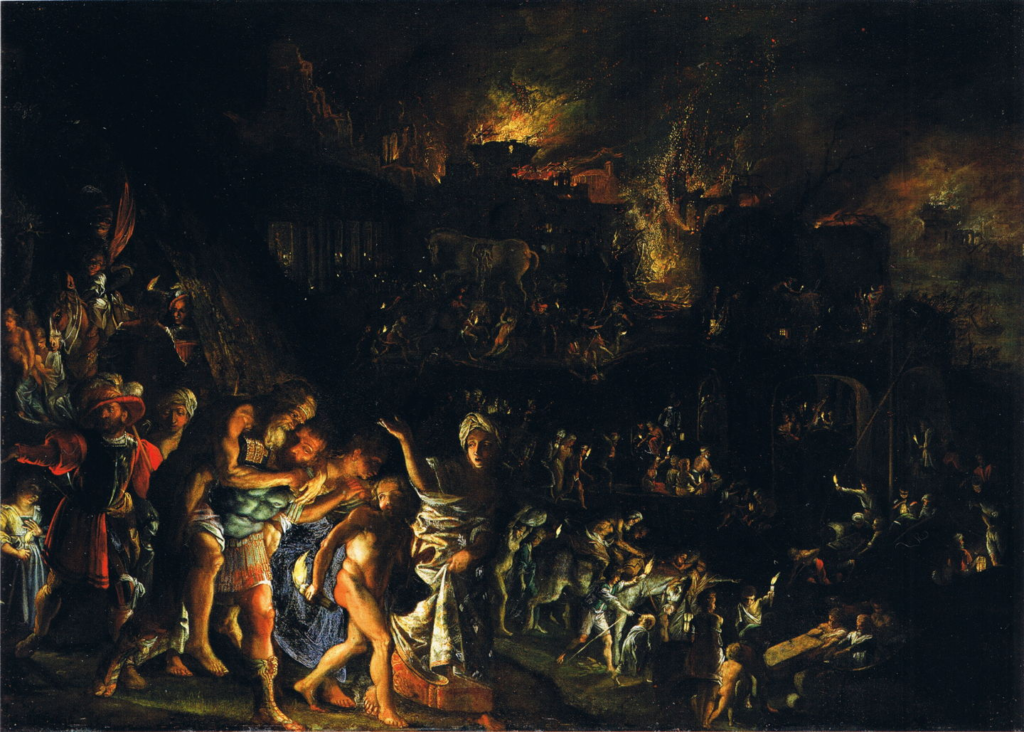
Odysseus is no outsider to this ethos. He devises the Trojan Horse stratagem that leads to Troy’s destruction; readily blinds the Cyclops Polyphemus to escape from his den; and upon his return to Ithaca, slaughters Penelope’s suitors besides decreeing that the twelve maidservants be hanged for defying the household. Nolan’s Odysseus is not such a man. Or not fully, at any rate. He is pained at the “ten years of rage” that poured out during the sack of Troy, and is contrite about his complicity in the murders, rapes, pillage, and desecrations of that night. But while our hero disavows this bloody past of his, he has no qualms about butchering Penelope’s suitors. If Homer’s hero is complex, Nolan’s makes his Odysseus strangely contradictory.
Far more disconcertingly, Nolan’s hero is a far cry from the crafty, heroic figure whom Homer memorialised in his epic with the epithet polymêtis (generally understood as one with “great cunning”). In the epic, the Cyclops episode is an iconic instance of Odysseus’s cunning and his hubris. The Cyclopes live as a community, and Polyphemus, whose lair Odysseus and his men enter, initially feigns hospitality – he asks them who they are; where they come from – before beginning to devour the sailors. Odysseus identifies himself as Outis (“Nobody”) and the Cyclops, pleased with the wine he is offered, promises to eat him last. Later, when Polyphemus is blinded and writhing in pain, he calls out to the other Cyclopes saying “Nobody” is hurting him; they dismiss his cries, assuming that no one is hurting him. As Odysseus escapes from the lair, he reveals his true name in a fit of hubris, and Polyphemus implores his father Poseidon that Odysseus never reach home, or, if he does, get there broken and alone. This is a singularly important episode in The Odyssey as Odysseus’s wanderings are a direct result of the sea-god’s anger at the treatment of his son.
Nolan turns Odysseus’s encounter with the Cyclops into a bit of a caricature. In the film, there is no community of Cyclopes, only Polyphemus. He looks like a bulkier one-eyed version of Gollum from The Lord of the Rings; he barely speaks, and he eats the sailors in a manner that recalls (a conscious decision on Nolan’s part) Goya’s painting, “Saturn Devouring his Son.” The “Nobody” name-game is dispensed with, as is Odysseus’s eventual disclosure of his own name (in the film, Odysseus shoots an arrow at the already blinded Cyclops). Polyphemus does appeal to his father to avenge his blinding, but this omission dramatically weakens the narrative logic of the film. Poseidon’s vengeance is not made obvious. And instead of a display of shrewdness and cunning, the film offers a one-dimensional encounter with a monster and a tale of surviving it.
Other omissions from the Homeric narrative, especially regarding female characters, add up to a story of missed opportunities. The Phaeacian episode is dropped, and with it the character of the teenage princess Nausicaa. Nolan combines the Calypso episode with that of the Lotus-Eaters. In Homer, the nymph Calypso detains Odysseus on her island of Ogygia against his wishes, and makes him sleep with her each night; he refuses her offer of immortality and longs to return to his wife in Ithaca; Calypso eventually lets him go on Zeus’s orders. In a wonderfully (proto)feminist moment in Homer’s epic, Calypso rails against the gods for their double standards about female sexual mores. In Nolan’s treatment, Calypso feeds Odysseus the lotus plant that induces pleasurable forgetfulness, in this case of his family in Ithaca and of the horrors of the Trojan War. This sanitises the sexual politics of the Homeric epic besides robbing Calypso and Odysseus of their moral ambiguities.
But some other characters are given a (proto)feminist gloss. Circe the enchantress, for instance: in the film, she feeds Odysseus’s fellow sailors and turns them into pigs, denouncing them as rapists and looters. When she returns them to their human form, Nolan’s Odysseus takes directions from Circe to make his way to the Underworld to meet the prophet Tiresias. In Homer, the hero chooses to remain with Circe for a further year as her lover before visiting the Underworld, something Nolan omits to keep his narrative universe and its moral codes straightforward and unambiguous. Missing from the Underworld encounters that Nolan crafts for his Odysseus is his meeting with the spectre of his mother, Anticlea. He is unaware of his mother’s death, and learns that she died of grief caused by his extended absence from Ithaca. It is a touching moment in Homer: Odysseus tries to embrace her three times, and each time she slips through his arms as if she were a shadow or a dream.
The character of Penelope is similarly transformed. She chafes at not being able to rule Ithaca as herself. When Telemachus says that the throne cannot be kept empty, she thunders, “Empty throne! I’ve been sitting on the throne for twenty years.” But Nolan gives, and Nolan also takes away. He diminishes the wiliness that characterised Homer’s Penelope. In the epic, after their reunion, Penelope does not accept Odysseus immediately; she asks the maid Eurycleia to move their marriage bed. This is a provocation for Odysseus. Only he and Penelope know that the bed cannot be moved, as Odysseus built it around an olive tree that grew in the middle of their house. No such test for the hero in the film. Instead, as he sets out for Troy, Nolan has Penelope give Odysseus a pin that he is always to wear, strangely reminiscent of the modern-day wedding ring.
The forced secularisation of the film is also jarring. All the gods, except Athena, are removed from the diegetic world of the film. Yet these gods are mentioned: Polyphemus asks his father, Poseidon, to avenge his blinding, but the sea-god is neither seen nor heard. The film shows storms and turbulence at sea, but one has to infer that these are Poseidon’s interventions. Similarly, we hear of the sun-god’s cattle and of Zeus’s law, but they remain beyond the ken of the film. Athena does appear – looking strangely swathed, as if about to be turned into a mummy – but only, it seems, as a manifestation of Odysseus’s tormented mind. There is nothing wrong with evicting the gods from the narrative, especially since there is always the danger that the portrayal of gods, particularly Graeco-Roman ones, could nudge a film towards an avoidable kitschiness. But Nolan wants to have his cake and eat it too. He neither fully removes nor fully incorporates the divinities into his film, making his effort look half-baked and uncharacteristically clumsy.
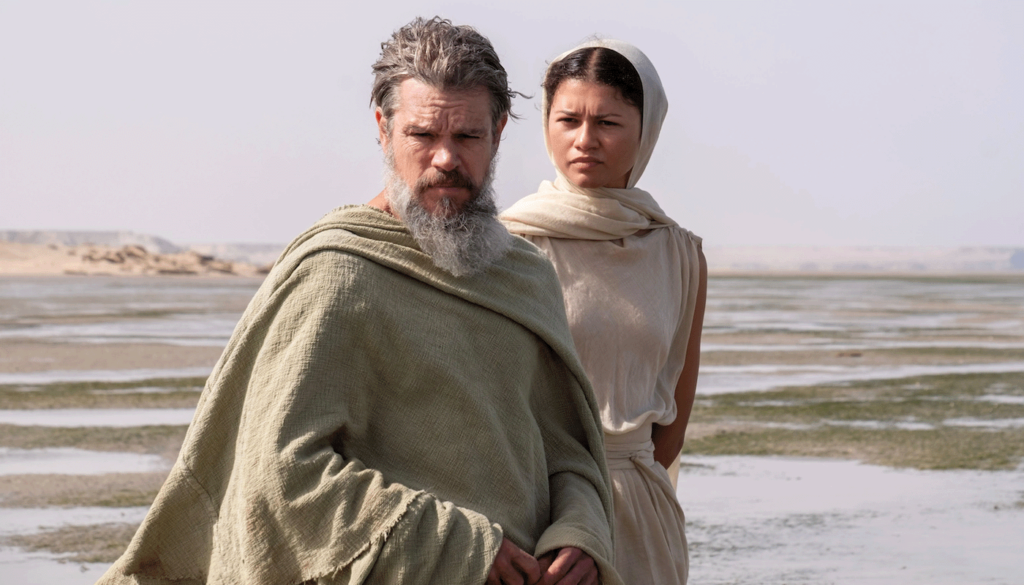
I expected a better script but found the writing uniformly mediocre. The film attempts a polyphony of different linguistic registers but ends up offering a bit of cacophony instead. Odysseus says, in an almost poetic idiom, “To burn the walls of Troy was to burn the world entire” – which sits awkwardly alongside “Ten years on this fucking beach,” which he tells his sailors as they set off for home. And the use of “mom”, “dad”, “daddy”, and “you wanna be king” is grating, and recalls for me the incongruity of hearing, throughout the otherwise magnificent Amadeus, Mozart being called “Wolfie” by his wife.
My frustration with Nolan is not that of a purist. Cultural texts are, and have historically been, subject to reimaginations across times and spaces – and so they should be. By the 6th and 5th centuries BCE, Greek tragic playwrights were drawing on myths and the oral traditions of the Greek epics – the extant ones by Homer as well as those now lost – to fashion their own narratives. In India, the Sanskrit epics have been reimagined in a host of literary and performative contexts. One can think of – to name just a few – Michael Madhusudan Dutt’s Bengali epic in blank verse Meghnadbadh Kabya [The Slaying of Meghnad, 1861], which reimagines the Ramayana to present Ravana’s son Meghnad (Indrajit) as its hero; Dharamvir Bharati’s Hindi verse-drama Andha Yug [The Blind Age, 1953] set in the last day of the Mahabharata war; and Shyam Benegal’s Kalyug [The Age of Vice, 1981] that reimagines the Mahabharata and locates it in a corporate-industrial world. Vishal Bhardwaj’s retellings of Shakespeare’s tragedies – Macbeth as Maqbool (2003), set in Mumbai; Othello as Omkara (2006), set in Meerut; and Hamlet as Haider (2014), set in Kashmir – are truly exceptional adaptations from more recent years.
Homer himself is no stranger to adaptations. James Joyce’s Ulysses and Derek Walcott’s Omeros are two of the most magnificent reimaginings of his work. As I watched Nolan’s Odyssey, I couldn’t help but remember what, to me, remains the best filmic adaptation of Homer – incidentally, also of The Odyssey – for modern times: the Coen brothers’ O Brother, Where Art Thou? (2000), which reimagines the epic and sets it in 1930s rural Mississippi. Their Ulysses Everett McGill (who corresponds to Odysseus and is played by George Clooney) seamlessly embodies the craft and cunning of the Greek epic hero. He is also, effortlessly and with panache, an American from the deep South.
The fundamental difference between all these reimaginations and Nolan’s film is that the others offer lifeworlds that are internally coherent and credible. When they impute contemporary ideas to characters from epics or tragedies, both those characters and the narrative worlds are rendered contemporary. Nolan’s film tries to bridge two worlds – Homer’s and ours – which in the end proves a bridge too far. Ultimately, viewers are left with an odd film, one that strives to be about both the ancient and the contemporary world but ends up nowhere. It turns out to be a tale of sound and fury, signifying little.
Subscribe to the newsletter
Free. Independent writing on cinema and adjacent arts, delivered by email.
Subscribe